


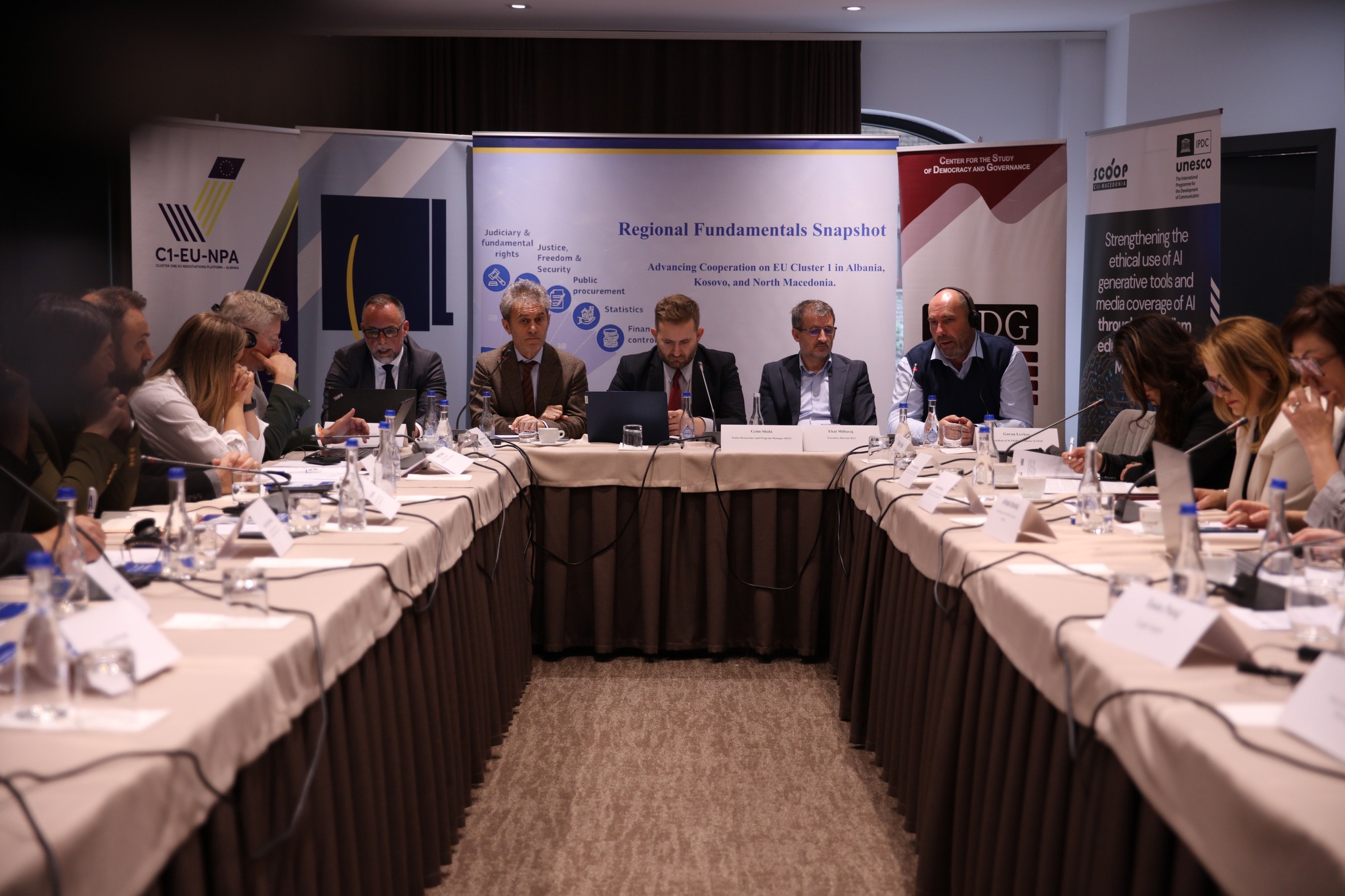
Kosovo Law Institute (KLI), in partnership with the Center for the Study of Democracy and Governance (CSDG) and the Center for Investigative Journalism (SCOOP Macedonia), with the support of the Western Balkans Fund (WBF), held today a roundtable discussion where it presented the publication “Regional Snapshot: Where Does the Region Stand in EU Cluster 1 – Fundamentals?”.
Representatives from the Office of the Prime Minister, the Ministry of Justice, the Ministry of Digitalization and Public Administration, the Kosovo Judicial Council, the European Union Office in Kosovo, the Embassy of the Kingdom of the Netherlands in Kosovo, the United Nations Mission (UNMIK), the OSCE Mission in Kosovo, and civil society participated in the roundtable.
The event opened with remarks from representatives of the three partner organizations: Ehat Miftaraj, Executive Director of KLI; Arjan Dyrmishi, Executive Director of CSDG; and Goran Levkov, Director of SCOOP Macedonia.
In the opening of the roundtable, Ehat Miftaraj, Executive Director of KLI, emphasized that Kosovo remains the last country in the region in terms of European integration and that there is a lack of political will to translate free elections into functional institutions.
Arjan Dyrmishi, Executive Director of CSDG, highlighted the importance of Cluster 1 as the foundation for state functioning, stressing that the integration process should focus on the internal development of countries and not only on membership.
Meanwhile, Goran Levkov, Director of SCOOP Macedonia, emphasized the need to strengthen regional cooperation and to build capacities to address shared challenges, including migration and labor shortages.
The presentation of the snapshot was delivered by KLI Senior Researcher Qemajl Marmullakaj, who emphasized that Kosovo remains behind the region in implementing the EU Growth Plan, with a delay of approximately 1.5 years and still at a very early stage of implementation. He further underlined that European integration is not merely a formal process, but a test of state functionality, where progress should be measured through concrete implementation of reforms rather than policy drafting alone. According to him, Albania remains the most advanced in the region, North Macedonia is at an intermediate level, while Kosovo continues to face structural challenges in the rule of law and institutional functioning. Marmullakaj added that the focus should be on depoliticizing institutions, increasing accountability, and improving institutional coordination, stressing that despite the challenges, the integration process remains a key driver of reforms in the region.
He also emphasized that due to Kosovo lagging behind regional countries in the integration process and its non-recognition by five EU member states, Kosovo is unable to join specialized EU agencies where information and experience are exchanged in implementing elements within Cluster 1. As a result, this complicates the work of Kosovo institutions and consequently the implementation of some of the criteria within the integration process.
Arlinda Krasniqi, Head of the European Integration Office at the Kosovo Judicial Council, stated that in 2025 there was an increase in the number of resolved high-profile corruption cases compared to 2023. She noted that the KJC has continuously worked on implementing recommendations from country reports and international mechanisms, investing in strengthening the capacity of the Special Department by increasing the number of judges, professional associates, and support staff. Krasniqi added that the KJC has worked to improve court efficiency, institutional transparency, and the functioning of judicial administration, emphasizing that justice reforms are a continuous process requiring long-term commitment and a systematic approach.
Gresa Selimi-Bytyqi, Head of the Judiciary and Fundamental Rights Division at the Office of the Prime Minister, highlighted the coordinating role of this institution in implementing reforms within the EU integration process. She noted that following the ratification of the Growth Plan agreement, steps have been taken to intensify efforts, including the establishment of coordination and management structures. However, she pointed out challenges related to the political situation, particularly the risk of delays in adopting and implementing legislative reforms, especially in concluding the initial phase. She added that some reforms, such as the Anti-Corruption Strategy and the Strategy against Organized Crime, do not depend directly on the Assembly and are being treated as priorities by relevant institutions despite the challenges.
Edmir Sejdiu, Acting Director of the Department for Public Administration Reform at the Ministry of Digitalization and Public Administration, stated that institutions are aware of delays in approving the Growth Plan, but despite this, they have managed to fulfill part of their obligations. He announced that on 16 April 2026, the first disbursement of funds amounting to €61.8 million was made, describing this as an indicator of a satisfactory level of progress, although not fully aligned with initial planning. According to him, despite challenges, including the 2025 electoral processes and delays in the Assembly, the administration has managed to advance some reforms and secure tangible benefits.
Alfons Benjamin Lentze, Policy Officer at the EU Office in Kosovo, stated that the European Union has a particular interest in the economic development of Western Balkan countries, emphasizing that the Growth Plan and financial support require absorption capacity and effective reform implementation. He stressed that progress in areas such as rule of law, education, energy, and healthcare is essential for improving citizens’ lives, adding that European integration is not limited to drafting laws and strategies but requires concrete implementation, monitoring, and accountability. According to him, obligations in this process are mutual and require responsibility from institutions and leadership. He also raised concerns about youth unemployment and migration risks, highlighting the need for policies that create economic and social prospects. He added that dialogue and political leadership engagement with the public must be strengthened, and that KLI’s report provides an important overview, although the reform process remains ongoing.
During the discussion on the rule of law, Miftaraj emphasized that recent developments directly affect its foundations, mentioning delays in appointing the Chair of the Kosovo Judicial Council and the dismissal of the Bar Exam Commission. He stressed that meeting EU criteria should not be driven solely by financial benefits but should reflect a change in institutional approach and behavior. He raised concerns about political interference in independent processes, noting that such cases demonstrate that the country remains far from European standards and values. He added that these developments negatively affect institutional functioning and undermine the principles of good governance and the rule of law.
Arben Hajredini from the OSCE media sector raised concerns regarding recent processes for selecting members of the Board of the Radio Television of Kosovo and the Independent Media Commission, noting that according to civil society findings, these processes were not in line with applicable laws and regulations. He added that these developments have been disappointing and affect public trust in institutions.
Andrea Lako from the United Nations Mission emphasized the importance of the European integration process for Western Balkan countries, noting that it has been a key mechanism for democratic development in the region. Speaking in a personal capacity, he stated that the European Union remains the only mechanism that makes democratic progress measurable in these countries, adding that without this process, institutional development would have been much more limited.
Selvije Elezaj from the Ministry of Justice emphasized that despite intensive institutional engagement in drafting policies and legislation, results have not reached the desired level. She agreed with KLI’s findings that the lack of functionality of the Assembly over the past year has negatively affected reform processes, including policy drafting and implementation. Ms. Elezaj mentioned concrete achievements such as the entry into force of the Law on Administrative Conflicts and the operationalization of the Administrative Court, as well as the drafting of strategic documents in the field of rule of law, noting that their implementation has faced difficulties due to institutional circumstances.
Venera Ramaj, Senior Rule of Law Officer at the Embassy of the Kingdom of the Netherlands, emphasized that the European integration process is fundamentally transformative and goes beyond formal legal changes, directly impacting citizens’ lives. She identified three main challenges in this process: lack of institutional integrity, political will, and human capacities. She also underlined the importance of civil society in properly communicating the integration process and the need to bring discussions closer to citizens by addressing existing misunderstandings.
At the conclusion of the conference, it was confirmed that, despite varying levels of formal progress, the main challenge for countries in the region remains ensuring concrete results and the sustainability of reforms in practice. In this regard, institutional coordination, building political consensus, and the active role of civil society in holding institutions accountable are of great importance. It was also emphasized that regional cooperation and the exchange of experiences are essential to accelerating progress, by learning both from the successes and failures of other countries. Ultimately, this regional snapshot aims not only to show where we stand, but to encourage a shift in approach—from focusing on formal harmonization to delivering measurable results and ensuring the real functioning of institutions, as a key condition for sustainable progress in the European integration process.
